Britain’s Strategic Drift, China’s Rise, and the Illusion of a New Order
By CJ Korpaczewski
For decades, the Anglo-American alliance appeared immovable. Politicians invoked shared history. Commentators invoked shared values. The “special relationship” was treated as geopolitical fact.
In reality, it was something much more material: a class arrangement.
After World War II, Britain no longer possessed the industrial base or financial leverage to lead a global empire. The United States did. Britain adapted by embedding itself within a U.S.-dominated system. The City of London became indispensable not by rivaling Wall Street, but by servicing it. British diplomacy reinforced American strategy. British military power supplemented American force projection.
It was not equality. It was managed subordination.
That arrangement endured as long as U.S. imperialism could provide something crucial: coherence. The United States functioned as organizer of global capitalism. It set monetary rules. It stabilized trade corridors. It coordinated security architecture.
Today, that organizing capacity is visibly strained.
A Hegemon Under Stress
The United States remains militarily unmatched and financially central. But dominance is not the same as stability.
Washington’s political system has grown volatile. Trade policy shifts sharply between administrations. Tariffs are imposed and lifted with little long-term predictability. Sanctions regimes expand rapidly. Allies find themselves caught in policy oscillations driven as much by domestic electoral cycles as by strategic design.
From the perspective of international capital, unpredictability is corrosive. Accumulation requires planning horizons measured in decades. If the center of the system becomes erratic, subordinate powers do not protest on moral grounds. They diversify.
British capital is doing precisely that.
Brexit and the European Contradiction
Brexit did not restore British sovereignty in any meaningful sense. It weakened Britain’s institutional leverage while leaving its economic dependencies intact.
Inside the European Union, Britain acted as a financial bridge between continental markets and American capital. Outside the EU, it lost influence over regulatory frameworks while remaining economically entangled with them.
The EU itself now navigates a parallel contradiction. It speaks of “strategic autonomy” while remaining anchored in NATO. The war in Ukraine accelerated European military spending and deepened sanctions against Russia, reinforcing transatlantic coordination even as leaders in Brussels discuss independence.
Britain stands awkwardly between these forces. Militarily tied to Washington. Economically bound to Europe. Financially open to Chinese capital.
This is not strategic clarity. It is structural tension.
China: Built by Western Capital, Now Competing with It
China’s rise is often narrated as the story of an outsider challenging the system. That narrative is misleading.
Western corporations relocated production to China voluntarily. They sought lower wages, disciplined labor forces, and state-backed infrastructure. The offshoring of manufacturing was not coerced. It was calculated. It raised profit margins and reshaped global supply chains.
The industrial strength that now concerns Western policymakers was constructed in large part by Western capital itself.
China today is not a socialist alternative to capitalism. It is a central pillar of global capitalism. Chinese firms accumulate capital abroad. Chinese banks finance infrastructure tied to resource extraction and trade corridors. Chinese corporations secure port access and logistics chains across continents.
The export of capital and the extraction of surplus value from dependent economies are not features of anti-imperialism. They are defining features of imperial expansion.
China has become not a counter-system, but a competing imperial center.
Tariffs, Sanctions, and the Global Cost of Rivalry
As competition intensifies, economic tools have become weapons.
Tariffs imposed during trade disputes are rarely absorbed by governments. They cascade through supply chains and inflate consumer prices. Sanctions isolate financial systems and redirect energy flows. Smaller economies find themselves navigating conflicting pressures from rival powers.
The war in Ukraine accelerated these dynamics. The United States and the European Union imposed sweeping sanctions on Russia, reshaping energy markets and financial flows. European states absorbed rising costs. Countries in the Global South recalibrated trade routes to avoid secondary sanctions while preserving access to Russian and Chinese markets.
Inter-imperial rivalry does not remain confined to diplomatic communiqués. It appears in electricity bills, food prices, and currency volatility.
Greenland, the Arctic, and Strategic Retrenchment
Strategic geography has reasserted itself with force.
The Arctic region, including Greenland, has gained renewed attention due to emerging shipping lanes, rare earth deposits, and missile defense positioning. Increased U.S. interest in Arctic infrastructure reflects concerns about Russian military activity and Chinese economic involvement in northern routes.
When hegemonic power weakens at the global level, it often consolidates closer to home. Emphasis on hemispheric security and control over strategic corridors does not represent isolationism. It represents recalibration under pressure.
The contest is not ideological. It is material.
Ukraine and the Hardening of Blocs
The war in Ukraine intensified alliance formation while revealing fractures within it.
NATO cohesion strengthened in the short term. The EU expanded sanctions regimes and increased military coordination. Yet energy costs, reconstruction contracts, and fiscal burdens expose divergent interests within the Western bloc.
Outside the transatlantic core, states have pursued pragmatic neutrality, maintaining economic relations across rival poles.
War has not simplified global alignment. It has complicated it.
No New Cold War
It is tempting to describe this moment as a new Cold War. That analogy comforts by implying symmetry and structure.
But today’s confrontation is not between capitalism and socialism. It is between rival capitalist powers embedded in the same global system.
The United States and China compete for markets, supply chains, financial leverage, and strategic dominance. Europe maneuvers within and around that rivalry. Britain attempts to remain relevant by hedging between poles.
Multipolar capitalism does not promise equilibrium. It promises instability.
Britain’s Dilemma
Britain lacks the economic weight to dominate either side of this rivalry. Its strategy is therefore one of maneuver.
Remain militarily aligned with Washington. Maintain financial access to Chinese markets. Preserve trade with Europe. Avoid full commitment while extracting advantage from all sides.
Such a position can persist for a time. It cannot resolve the underlying contradictions.
A System Without Resolution
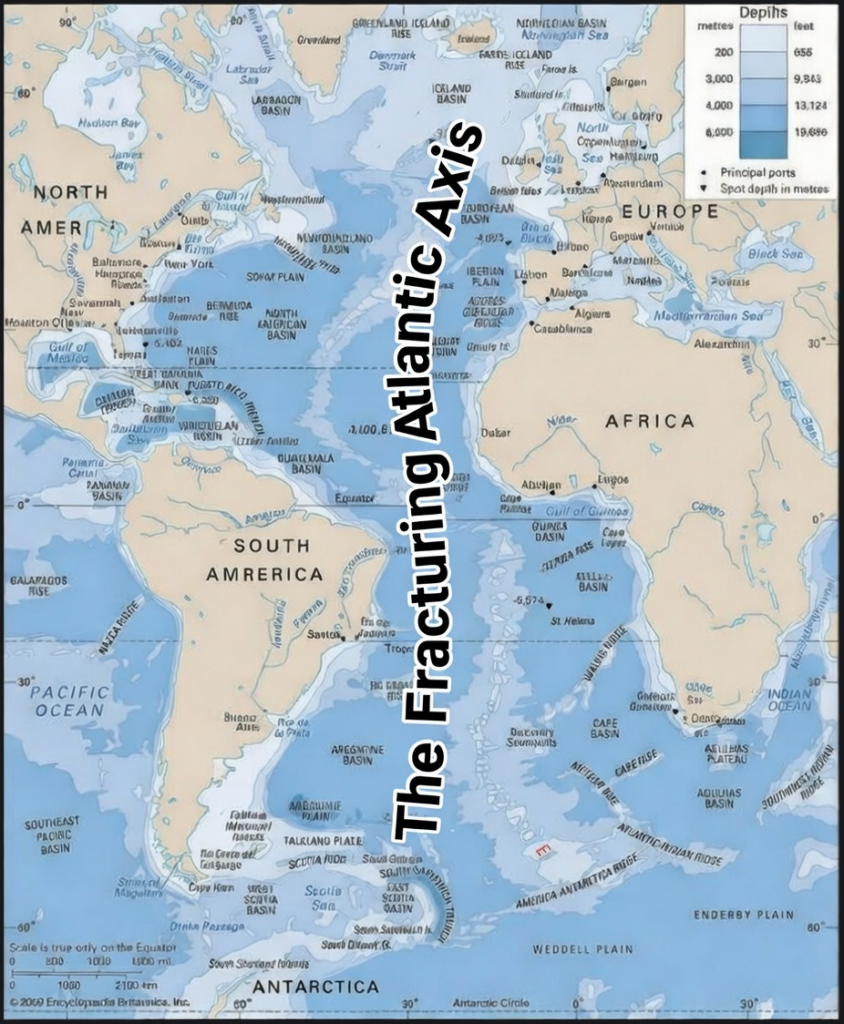
The fracturing of the Atlantic axis does not signal the emergence of a more just order. It signals the erosion of a hegemonic arrangement that once imposed coherence.
Western capital built China’s industrial capacity in pursuit of profit. China now competes at the level of capital export and resource extraction. The United States responds with tariffs, sanctions, and strategic consolidation. Europe seeks autonomy without severing ties. Britain navigates between them.
What emerges is not transformation, but intensified rivalry within capitalism itself.
There is no progressive pole in this configuration. There is only competition over accumulation, territory, and leverage.
The special relationship is weakening not because values have changed, but because material foundations are shifting. And when foundations shift in a system organized around profit and power, the result is not balance.
It is friction.