Para leer este artículo en español haga click aquí
Mexico City, September 13, 2026
Beneath the façade of continuity championed by the self-described Fourth Transformation, the government of President Claudia Sheinbaum and the Morena party have sealed their complicity with big transnational capital by ratifying that the construction of the Gas y Petroquímica de Occidente (GPO) ammonia plant in Topolobampo “continues” and is not canceled, hiding behind the bureaucratic cynicism that the project boasts over 95% completion. Facing this government pact with the Swiss consortium Proman, the permanent resistance encampment established by the “¡Aquí No!” collective and the Mayo-Yoreme communities in the Ohuira Bay has just reached one hundred days of continuous resistance—a milestone of struggle that recently escalated to the political heart of the country with protests and deployments in the Zócalo of Mexico City.
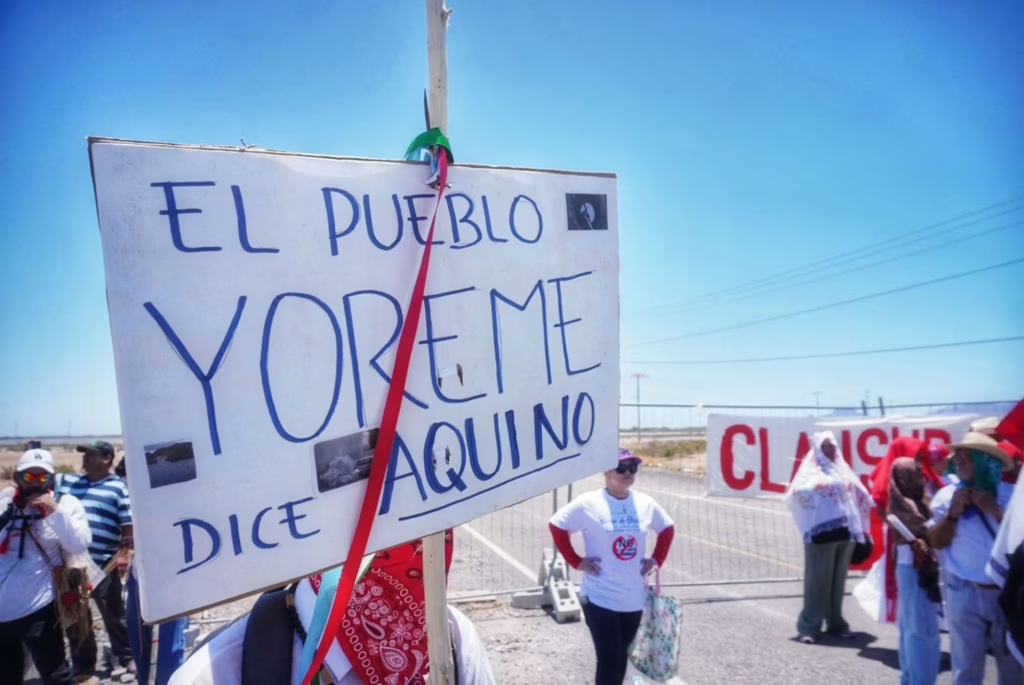
Indigenous peoples of Topolobampo protest outside the GPO ammonia megaplant on June 7.
Foto: Armando Quiroz (Cuartoscuro)
Read more: Ecocide in Topolobampo and Capitalist Barbarism: Institutional Complicity in the Face of Planetary CrisisThis radical dispute against the imposition of one of Latin America’s largest petrochemical plants, nestled in northern Sinaloa within a lagoon system, marshes, and mangroves of international importance cataloged as a Ramsar site—where the artisanal fishing of nearly four thousand riverside fishers residing in communities such as Ohuira, Lázaro Cárdenas, and Paredones struggles to survive—transcends the regional sphere to become a critical node in the global ecological and civilizational crisis. Formally unleashed in 2014 with conditional environmental permits and prolonged for over a decade of injunctions and Supreme Court rulings, the defense of the bay precisely illustrates how contemporary capitalism operates: it externalizes environmental destruction onto the territories of the semi-colonial or dependent countries while prioritizing private accumulation and the supply chains of industrial agribusiness over the sustainability of ecosystems.
This systemic voracity occurs within a context of documented environmental collapse: global scientific assessments indicate that seven of the nine planetary boundaries have been breached—including climate change, biosphere integrity, freshwater use, and the recent transgression of ocean acidification—while greenhouse gas emissions have reached a historic high of 56.8 billion metric tons of CO2 equivalent, driving atmospheric carbon dioxide concentrations to 425.6 ppm and maintaining a global thermal anomaly that consolidates the past decade as the warmest in recorded history.
In this scenario of extreme planetary vulnerability, the stance of the Morena officialdom and the federal administration toward the ammonia plant evidences the continuity of a state policy that subordinates territorial sovereignty and ecological sustainability to corporate interests. Validating a petrochemical mega product imposed on a protected wetland by cataloging it as a fait accompli simply because it is administratively advanced dismantles official rhetoric regarding the supposed centrality of the peoples. By minimizing the historical opposition of the Mayo-Yoreme people, the federal government acts as an efficient manager of corporate interests, reducing the rights of indigenous communities to mere bureaucratic simulations of participation.
Despite the Executive’s opening of technical review tables and environmental analysis groups, the communities and allied organizations such as Greenpeace have made it clear that participating in these processes does not equate to endorsing construction. The sustained resistance in the Ohuira Bay encampments demonstrates that for institutional power structures, the climate crisis and community survival remain secondary to corporate demands.
Therefore, ahead of the Ecosocialist Conference in Australia beginning this weekend, an urgent call is made to the international left and to all participants gathered there to break the complicit silence, categorically condemn this ecocide, and demand the definitive cancellation and total closure of the ammonia plant in Topolobampo. The defense of the Ohuira Bay and the Mayo-Yoreme territory is not merely a local cause, but a fundamental trench in the global fight against capitalist barbarism; effective environmental protection demands internationalist solidarity and the militant action of peoples halting a model driving the planet toward collapse.