U.S. Imperialism Attacks Venezuela to Take Direct Control of Its Resources
Socialists Without Borders Statement 1/3/2026
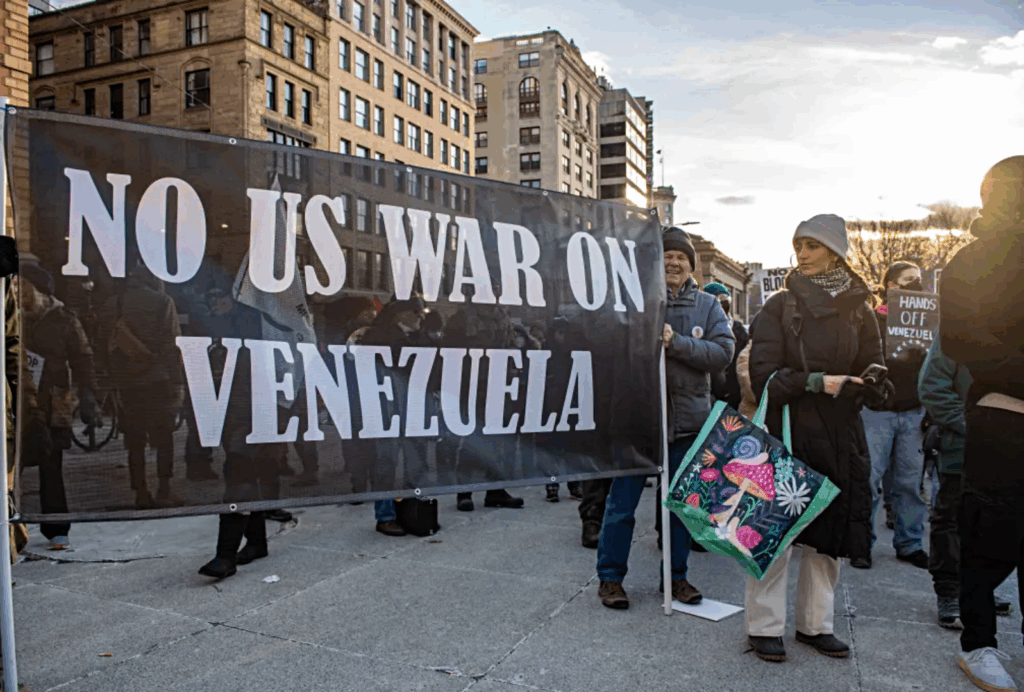
We, Socialists Without Borders, unequivocally denounce the U.S. imperialist assault on Venezuela launched on January 3, 2026, marked by aerial bombardment, the seizure of state infrastructure, and the forcible abduction of Nicolás Maduro and his wife. This was not a defensive action, not a humanitarian mission, and not a legitimate law-enforcement operation. It was a regime-change intervention designed to impose direct U.S. control over Venezuela’s political future and natural resources.
President Trump stated openly that the United States will now run Venezuela, dispensing with the usual liberal pretenses about democracy or sovereignty. This declaration clarified what imperialism often tries to obscure: the intervention is about colonial administration, not “restoring order.” At the same time, contradictions within the U.S. ruling class surfaced immediately. Trump framed the operation as being about oil, while Defense Secretary Pete Hegseth insisted it was about drug trafficking. These mutually exclusive justifications reveal the true nature of imperialist war: the narrative is improvised after the fact to justify actions already decided by capital.
The operation was deliberately framed as a law-enforcement action, not a military invasion. Maduro was seized not by uniformed U.S. troops but by U.S. federal police forces, specifically the DEA, backed by intelligence assets and air power. This maneuver is not accidental. It represents a dangerous precedent in which imperialism recasts invasion as arrest, occupation as prosecution, and war as policing.
Neither Venezuela’s vice president nor Washington’s preferred opposition figures—including internationally celebrated liberals and right-wing politicians, some decorated by elite global institutions—exercise real authority. Their own statements acknowledge that decision-making power resides entirely in Washington. They are not rulers, but caretakers awaiting instructions.
Trump has already threatened a second wave of attacks should Venezuela fail to comply with U.S. demands for full access to oil resources, confirming that this is not a limited action but an open-ended imperial project.
From Hybrid War to Open Aggression
This invasion is the culmination of a prolonged hybrid war against Venezuela, combining economic strangulation, diplomatic isolation, covert operations, and now open coercion.
At the core of this campaign were sanctions: the freezing of Venezuelan state assets abroad; the prohibition on negotiating sovereign debt and the bonds of Petróleos de Venezuela, S.A. (PDVSA)—the state-owned oil company that forms the backbone of the Venezuelan economy; restrictions on the Central Bank; the revocation of operating licenses for energy firms; the seizure of aircraft and oil tankers; and punitive trade measures. These policies shattered normal trade, collapsed oil production, and drove mass migration.
Sanctions have now given way to direct force. Naval deployments, air strikes, intelligence operations, and targeted seizures are no longer concealed. Civilian infrastructure and shipping are attacked under the language of “security.” Imperialism has dropped the mask.
Demystifying Chavismo: Maduro as Chávez’s Successor
From a Trotskyist standpoint, clarity is essential. Maduro did not lead a socialist or workers’ government.
As the political successor to Hugo Chávez, Maduro inherited the language, symbolism, and historical legitimacy of Chavismo, but not a revolutionary rupture with capitalism. Venezuela under his rule was not socialist, nor meaningfully transitioning toward socialism. It remained a capitalist state that defended private property and bourgeois social relations, increasingly through authoritarian methods.
The Maduro government presided over the consolidation of a military-bureaucratic caste commonly known as the Bolibourgeoisie. The term—combining Bolivariano and bourgeoisie—emerged during the Chávez years and was originally coined by critical Chavistas to describe a new layer of officials, military officers, and business intermediaries who enriched themselves through proximity to the state while cloaking their accumulation in revolutionary rhetoric.
This layer did not abolish capitalism; it adapted to it. The Bolibourgeoisie functioned as a state-dependent bourgeois class, using control over oil revenues, import licenses, currency exchange, customs, mining, and food distribution to accumulate private wealth. Unlike the traditional bourgeoisie, it did not arise from independent production but from parasitism on the state apparatus. Under Maduro, this caste solidified its power while workers faced collapsing wages, hunger, and repression.
State control over oil revenues and the Central Bank did not translate into workers’ power or democratic planning. Minimal subsidies were used to contain unrest while corruption and capitalist accumulation flourished. Independent unions, strikes, and popular organizations were systematically repressed.
Under imperialist pressure, Maduro sought accommodation with foreign capital, particularly in oil and mining. Rather than mobilizing workers independently against imperialism, the regime bargained from above—exposing its class character.
We oppose unconditionally the imperialist removal of Maduro. At the same time, we do not politically defend his regime. U.S. intervention does not correct authoritarian capitalism; it replaces it with direct imperial domination, opening the door to neoliberal and far-right rule.
Monroe Doctrine 2.0 and the Pro-Imperialist Opposition
The assault on Venezuela is the clearest expression yet of a renewed Monroe Doctrine, now enforced without apology. Its objective is total control of strategic resources and the elimination of even limited national autonomy.
Imperialism does not act alone; it always arrives with a supporting cast. Pro-imperialist opposition figures—celebrated abroad, paraded through international forums, and polished into “democratic alternatives”—serve as political accessories rather than decision-makers. The awarding and nomination of international prizes to such figures is part of a grotesque image-washing operation, a kind of political dry-cleaning meant to scrub away the visible stains of foreign intervention, austerity, and repression.
That a politician can openly invite imperialist intervention one day and be nominated for a peace prize the next would be comical if it were not so destructive. These honors function less as recognition than as certificates of reliability, assuring global capital that its local representatives are obedient, predictable, and ideologically house-trained. Their immediate irrelevance after the intervention only confirms their true role: decorative legitimacy, not sovereignty.
Right-wing governments across Latin America have aligned with this operation, exposing themselves as semi-colonial allies of U.S. capital.
Historical U.S. interventions—from the U.S.-backed coup against Salvador Allende in Chile in 1973, to the invasion of Panama, to decades of coups, sanctions, proxy wars, and occupations—follow a consistent pattern: the destruction of popular movements, the installation of authoritarian regimes, the plunder of resources by multinational corporations, and deepened mass immiseration. Venezuela is not an exception but a continuation of this imperial tradition, confirming Lenin’s analysis of imperialism as capitalism in its most predatory form.
A War Without Symmetry and the Illusion of Stability
Venezuela had no capacity to defeat U.S. imperialism militarily under Maduro, and any imposed successors are even less capable of resistance. Washington’s preference for bombardment, sanctions, police-style invasions, and proxy governance reflects a strategy of domination with minimal political cost.
The risk of escalation into a broader inter-imperialist conflict remains limited—not due to restraint, but due to alignment. French President Macron and British Prime Minister Starmer both endorsed the overthrow, confirming that this intervention enjoys consensus across the Atlantic imperialist bloc. Europe is not a counterweight to U.S. aggression, but a junior partner in enforcing imperial order.
Muted objections elsewhere reflect tactical differences, not opposition. As always, the illusion that rival imperialist powers will defend oppressed nations collapses on contact with reality. Only the international working class can stop imperialist war.
For Independent Working-Class Leadership
Trotskyists reject the false choice between U.S. imperialism and nationalist capitalist regimes. The task is to build independent working-class leadership.
Venezuelan workers must organize strikes, mass mobilizations, and self-defense against any puppet authority, creating councils as organs of revolutionary power. Workers in the United States and internationally must oppose the war through strikes, protests, and refusal to cooperate with repression—turning imperialist war outward into class struggle inward.
Our Program
Leave It in the Ground! – Eco-Socialism and Energy Transition
Raise the banner “leave the oil in the ground” as a revolutionary eco-socialist strategy. Capitalism’s dependence on fossil fuels is not only a driver of imperialist war but a direct cause of planetary destruction. The continued burning of oil, gas, and coal is accelerating climate collapse, devastating ecosystems, and threatening the material basis of human life. Venezuela’s liberation cannot rest on extractivism—national or foreign-owned—but on a planned transition to sustainable energy under workers’ control.
Emergency Solidarity from Below
Demand immediate continental aid to Venezuela, organized and distributed by workers’ organizations, unions, communes, and popular assemblies—not imperialist institutions or occupying authorities.
Continental Revolutionary Marxist Assembly
Call for a Continental Assembly of revolutionary Marxist organizations to coordinate strategy, solidarity, and material support. By revolutionary Marxist, we mean organizations rooted in the same political tradition commonly called Trotskyist: uncompromising opposition to imperialism, rejection of class collaboration, defense of working-class independence, and commitment to international socialist revolution. The task is not branding, but political clarity and coordinated action.
For a Workers’ Government
Fight for a government of unions, peasants, communes, and the oppressed—breaking with capitalism, dismantling the Bolibourgeoisie and imperialist puppets, ending repression, and confronting imperialism through international working-class solidarity.
The resolution of Venezuela’s crisis lies not in occupation, liberal restoration, or nationalist capitalism, but in international socialist revolution.
Release Nicolas Maduro and Cilia Flores Now!
Down with U.S. imperialism.
Down with authoritarian capitalism and fascist puppets.
For international socialism and workers’ power.